Learning how to read nutrition labels can certainly make you more mindful of what you are consuming.
It’s also a good way of helping you to cut back on the things we tend to eat too much of, as well as being able to identify which products are higher in vitamins/minerals and fibre.
Understanding what’s in the food you eat is a good step towards improving your overall health.
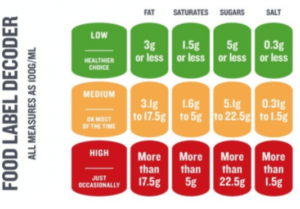
Here are some tips for understanding how food labeling works and I would recommend printing out a Food Label Decoder (as seen below) to keep in your purse/wallet to use when you go shopping.

Ingredients lists
Most pre-packaged foods have an ingredients list on the back of the packet.
Everything that goes into your food will be listed in weight order from biggest to the smallest.
Hence, if the first products on the list are sugars or butter etc then these make up the largest proportion of the product.
Comparing products
If you are going to compare products, a fairer way is to look at the per 100g column, as opposed to the portion size. It’s important to note that some products might contain more overall calories but this is because the portion size might be bigger.
Focus on Columns
The four biggest nutritional columns to focus on are sugar, total fat, saturated fat, and salt as these have the biggest impact on weight and overall health.
Sugar
Sugar can be disguised as many different names – honey; syrup and nectar to name a few.
They might sound like healthier alternatives but be warned, if it’s on the ingredients list of a product then it’s added sugar, however natural it sounds.
The recommended daily amount of sugar for an adult is 6 teaspoons.
Watch out for anything ending with ‘ose’ such as fructose, glucose and maltose etc.
Low sugar: 5g or less per 100g
High sugar : 22.5g or more per 100g
Fat
Fat tends to have a bad reputation but this macronutrient is essential for our bodies and needed for energy, as well as absorbing vitamins and minerals.
Not all fats are equal, so understanding the differences on labels is important.
Saturated fats found in red meats, butter, biscuits and cakes can raise cholesterol levels and increase risk of heart disease etc.
Unsaturated fats found in nuts, seeds and oily fish have a good impact on your health and are a good source of essential fatty acids.
Check the nutrition information per 100g to see whether the fat content is high, medium or low:
Low fat: 3g or less per 100g
High fat: 17.5g or more per 100g
Low saturated fat: 1.5g or less per 100g
High saturated fat: 5g or more per 100g
Salt
The recommended amount of salt per day is 6 grams which is around a teaspoonful.
Most of us consume double this amount which increases the risks of high blood pressure and cardiovascular disease. Bread and bacon are two of the biggest culprits.
Salt can be disguised as sodium on the ingredients list so watch out for this. To work out how much sodium is in a product you need to multiply the amount by 2.5 to work out the salt content.
Low salt: 0.3g or less per 100g (or 0.1g sodium, or 100mg sodium)
High salt: 1.5g or more per 100g (or 0.6g sodium, or 600mg sodium)
The above points provide a very brief overview of what to look out for in products and can be an excellent tool for making better decisions about what you eat and drink.